

Replacing or repairing a hot tub, spa, or bath pump can be confusing because a pump is made up of several different components, and many pumps that look similar are not interchangeable.
The good news is that you do not always need to replace the entire pump. Depending on what has failed, you may only need a replacement motor, wet end, impeller, shaft seal, or another pump component.
This guide explains how to identify the pump you have, which specifications matter, and how to determine whether you should replace the complete pump or repair part of the existing assembly.
Start With the Pump Identification Label
The best place to begin is the identification label located on the motor or pump assembly.
Depending on the manufacturer, the label may provide:
- Manufacturer name
- Pump model or part number
- Motor model number
- Horsepower
- Total horsepower
- Voltage
- Amperage
- Motor speed
- Frame size
- Service factor
- Electrical specifications
Take a clear photograph of the entire label before removing the pump. Even if some of the information does not appear important at first, it may become useful when identifying a replacement.
Know the Difference Between the Pump and the Motor
The terms pump and motor are often used interchangeably, but they are not the same thing.
A typical spa pump consists of two major sections:
- Motor: The electrical component that provides the power.
- Wet end: The water-handling portion containing the impeller, volute, seal, and plumbing connections.
The motor turns the impeller inside the wet end, which moves water through the spa plumbing.
If the motor fails but the wet end is still in good condition, you may be able to replace only the motor. If the wet end is cracked or damaged but the motor is good, replacing only the wet end may be possible.
What Is a Pump Wet End?
The wet end is the portion of the pump that actually moves water.
It typically includes:
- Volute or pump housing
- Impeller
- Diffuser, when used
- Shaft seal
- Seal plate
- Suction connection
- Discharge connection
If your pump motor runs properly but the wet end is cracked, leaking, or damaged, replacing the pump wet end may be more economical than replacing the complete pump.
What Does the Impeller Do?
The impeller is the rotating component inside the wet end that moves water.
When the motor shaft turns, the impeller creates the flow that moves water through the circulation or jet system.
An incorrect or damaged impeller can cause:
- Reduced water flow
- Poor jet performance
- Motor overload
- Noise or vibration
- Improper pump performance
Replacement impellers must be matched to the correct pump series, wet end, motor configuration, and horsepower application.
Browse our Pump Impellers when repairing an existing wet end.
What Is a Pump Shaft Seal?
The shaft seal creates a watertight seal where the motor shaft passes into the wet end.
A leaking shaft seal is one of the most common pump repairs.
Signs of a failed shaft seal can include:
- Water leaking between the motor and wet end
- White mineral deposits around the shaft area
- Rust or corrosion near the front of the motor
- Water dripping beneath the pump while it is operating
If a shaft seal leaks for an extended period, water can eventually damage the motor bearings and turn a relatively inexpensive seal repair into a complete motor or pump replacement.
Many seals, gaskets, O-rings, diffusers, seal plates, and other repair components can be found in our Pump Parts section.
48-Frame vs. 56-Frame Spa Pump Motors
One of the most important specifications when replacing a spa pump motor is the motor frame size.
Two common spa motor configurations are 48-frame and 56-frame.
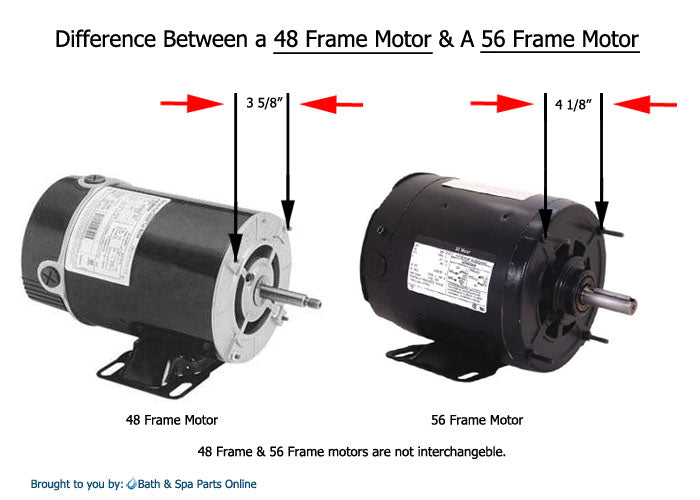
A useful way to identify the frame is to measure the spacing between the motor's thru-bolts.
As shown above:
- 48-frame motors: approximately 3-5/8 inches between the thru-bolts
- 56-frame motors: approximately 4-1/8 inches between the thru-bolts
The larger 56-frame motor generally has a larger diameter and different wet-end mounting dimensions than a 48-frame motor.
Match Voltage Before Anything Else
A replacement motor must be compatible with the electrical supply and spa control system.
Common spa pump motors may operate at:
- 115 volts
- 230 volts
- Dual voltage, depending on the motor
Never assume voltage based on horsepower or physical size.
A motor wired for the wrong voltage can fail immediately, operate incorrectly, or create a serious electrical hazard.
Check Whether the Pump Is One-Speed or Two-Speed
Spa pumps are commonly available in one-speed and two-speed configurations.
One-Speed Pumps
A one-speed pump operates at a single motor speed whenever it is energized.
Two-Speed Pumps
A two-speed spa pump can operate at both low and high speed.
Low speed may be used for filtration, circulation, or heating, while high speed operates the spa jets.
A two-speed pump generally requires a compatible control system and appropriate wiring. Do not replace a two-speed motor with a one-speed motor without verifying how the system is designed to operate.
Don't Match a Pump by Horsepower Alone
This is one of the most common pump-replacement mistakes.
A pump labeled 2.0 HP is not automatically interchangeable with every other 2.0 HP pump.
Horsepower ratings can be presented differently between manufacturers and product generations. In addition, the motor's service factor can affect its actual output.
The more meaningful measurement is often Total Horsepower (THP).
Total horsepower is calculated by multiplying:
Horsepower × Service Factor = Total Horsepower
When replacing a motor, compare the complete electrical and mechanical specifications rather than simply matching the largest horsepower number printed on the label.
Check the Amperage
Motor amperage can provide another important comparison point when identifying a replacement.
Compare the amperage rating of the original motor with the proposed replacement along with:
- Voltage
- Speed
- Frame
- Total horsepower
- Motor configuration
A replacement motor with dramatically different electrical characteristics deserves closer inspection before installation.
Measure the Plumbing Connections Correctly
Spa pump plumbing sizes can be confusing because the nominal plumbing size is not the same as the outside diameter of the threaded union.
Common spa pump connections include nominal sizes such as:
- 1-1/2 inch
- 2 inch
- 2-1/2 inch
Do not place a ruler across the outside of the threaded fitting and assume that measurement is the plumbing size.
Whenever possible, identify the original pump or wet-end part number before relying on measurements alone.
Check the Suction and Discharge Orientation
The location of the plumbing connections is another critical part of pump identification.
The suction is generally the inlet at the center of the wet end.
The discharge is where water exits the pump and may be positioned at the top or side of the wet end depending on the pump design.
Many spa pump wet ends can be rotated to accommodate different plumbing orientations, but this should be verified before ordering.
Circulation Pump vs. Jet Pump
Not every hot tub pump performs the same job.
Circulation Pumps
Circulation pumps are generally smaller pumps designed to continuously or periodically move water through the filter, heater, and sanitation system.
Jet Pumps
Jet pumps provide the higher water flow required to operate therapy jets.
Some spas use one pump for multiple functions, while others use a dedicated circulation pump plus one or more jet pumps.
Identifying what the original pump does is essential before selecting a replacement.
When Should You Replace Only the Motor?
Motor replacement can make sense when:
- The wet end is still in good condition
- The pump housing is not cracked
- The impeller and internal components are reusable or replaceable
- The correct replacement motor is available
- The motor is the primary failed component
Browse our current Pump Motors when the motor itself is the problem.
When Should You Replace the Wet End?
A wet-end replacement may make sense when:
- The motor still operates properly
- The volute is cracked
- The original wet end has severe damage
- Internal pump components have deteriorated
- A complete replacement wet end is more practical than rebuilding the existing one
Browse our Pump Wet Ends for current replacement options.
When Does a Complete Pump Replacement Make More Sense?
Sometimes replacing the complete pump is the better solution.
Consider complete replacement when:
- The motor and wet end are both heavily worn
- The original pump is obsolete
- Multiple major components need replacement
- The pump housing is damaged
- Corrosion has affected the motor and wet end
- The correct replacement assembly offers better long-term parts availability
Browse our complete Pumps collection for current bath, spa, circulation, and pool pump options.
Common Balboa Pump Families
Balboa Water Group and its associated Vico pump lines have been used extensively in bath and spa systems over the years.
Some commonly encountered Balboa and Vico pump families include:
- Gemini bath pumps
- Olympian bath pumps
- WOW bath pumps
- Dura-Jet spa pumps
- Ultima spa pumps
- Ultimax spa pumps
- Niagara pump configurations
- Balboa circulation pumps
Some older models within these families have been discontinued or replaced over time, so always identify the original part number before assuming the exact original pump must still be available.
Before Ordering a Replacement Pump
Gather as much information as possible before placing an order.
Ideally, verify:
- Pump manufacturer
- Pump model or part number
- Motor model number
- Voltage
- Amperage
- One-speed or two-speed operation
- Horsepower and total horsepower
- 48-frame or 56-frame motor
- Suction plumbing size
- Discharge plumbing size
- Discharge orientation
- Electrical connection style
Clear photographs of the motor label, complete pump, wet end, plumbing connections, and electrical connections can also make identification much easier.
Repairing the Pump? Start With the Component That Failed
You do not necessarily need a complete new pump every time something goes wrong.
Use these sections to locate the part you need:
- Complete Pumps – for complete pump replacement
- Pump Motors – when the electrical motor has failed
- Pump Wet Ends – for damaged or worn water-handling assemblies
- Pump Impellers – when repairing the rotating component inside the wet end
- Pump Parts – for shaft seals, gaskets, O-rings, diffusers, seal plates, hardware, and other repair components
Start by locating the part number and specifications on the original pump or motor label. Then compare the motor, wet end, plumbing, electrical specifications, and pump configuration before ordering.
If you're still unsure, give Bath & Spa Parts Online a call at 800-918-9143. Clear photos of the pump, motor label, wet end, and plumbing connections can help us identify what you have.
Need a Pump Diagram or Additional Help?
Our Knowledge Base includes pump diagrams, troubleshooting information, identification guides, and replacement-part resources for many common pool, spa, and bath systems.
If you encounter pump terminology you are unfamiliar with, our Common Pool & Spa Pump Terms guide explains many of the terms used when identifying and repairing pump equipment.
The Right Pump Repair Starts With Proper Identification
The most important thing to remember is that a pump should be identified by more than its appearance or horsepower.
Part number, voltage, amperage, speed, motor frame, total horsepower, plumbing size, wet-end configuration, and electrical requirements all help determine compatibility.
Once you know what you have, you can decide whether the best repair is a new motor, wet end, impeller, shaft seal, other pump component, or complete replacement pump.