
Balboa Bath & Spa Pump Replacement Guide
Balboa bath and spa pumps have been produced in many motor, wet-end, plumbing, and electrical configurations. Some older pumps are still available, while others have been discontinued or replaced by newer assemblies.
The most reliable way to identify a replacement is to compare the electrical requirements and physical configuration of the existing pump rather than relying on horsepower or appearance alone.
One of the most important indicators of the motor load the spa control system is designed to handle.
Confirm whether the pump operates at 115V, 230V, or another specified voltage.
Single-speed, two-speed, and circulation pumps are not interchangeable by appearance alone.
Check suction, discharge, union size, orientation, wet end, cord, and overall dimensions.
What Information Should You Gather From the Old Pump?
From the Motor Label
- Voltage
- Amperage at each speed
- Horsepower
- Service factor, if shown
- RPM or speed information
- Motor frame
- Manufacturer and motor number
From the Complete Pump
- Pump manufacturer and part number
- Wet-end model or molded numbers
- Suction plumbing size
- Discharge plumbing size
- Discharge orientation
- Electrical cord / plug style
- Overall length and available equipment-space clearance
Photograph Both Labels and the Entire Pump
The motor label identifies the motor, but it may not identify the complete Balboa pump assembly. Photograph the complete pump, wet end, unions, discharge position, cord, motor label, and every readable part number before removing the old unit.
48-Frame vs. 56-Frame Spa Pump Motors
Frame size affects the motor's physical dimensions and how it mates to the wet end. Balboa spa pumps commonly use 48-frame or 56-frame motors, and those frame sizes should be verified rather than guessed.
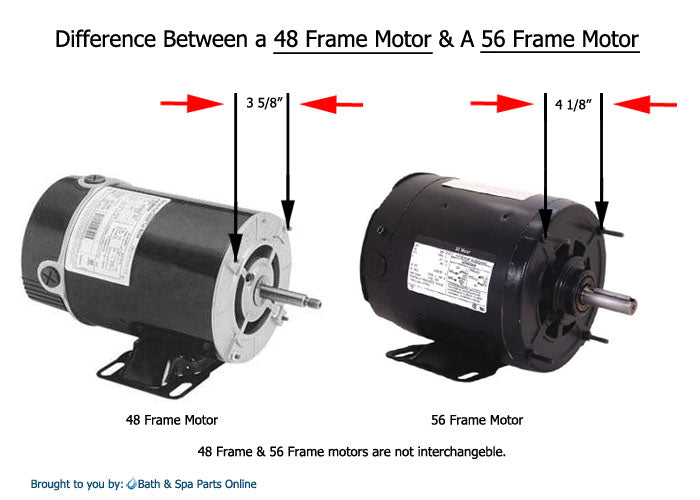
The existing comparison image helps show the physical differences between common 48-frame and 56-frame pump motors.
Check the Label First
Some motors identify the frame directly on the nameplate. If it is clearly shown, record it along with amperage, voltage, speed, and other electrical information.
Measure When the Label Is Unclear
Motor dimensions and thru-bolt spacing can help distinguish common spa motor frames. Do not rely only on the outside diameter of the motor housing.
How to Match a Replacement Pump
| Specification | Why It Matters |
|---|---|
| Amperage | Helps determine electrical compatibility and motor load. This should be one of the first comparisons. |
| Voltage | The replacement must be compatible with the spa's control system and supply voltage. |
| Number of Speeds | A two-speed spa pump requires separate low- and high-speed operation; a single-speed pump does not. |
| Motor Frame | Affects motor dimensions, mounting, and wet-end compatibility. |
| Horsepower | Useful as supporting information, but should not be used as the primary replacement criterion. |
| Plumbing Size | Suction and discharge connections must match the plumbing or be adaptable without creating a poor installation. |
| Discharge Orientation | Top, side, and center discharge positions affect how the pump fits the existing plumbing. |
| Wet End | The impeller, volute, diffuser, seal, and wet-end design determine hydraulic loading and fit. |
| Cord / Plug | Connector style, wire count, and cord length can differ between pumps. |
| Physical Fit | Overall length, base, motor diameter, and nearby plumbing determine whether the replacement fits the equipment compartment. |
Why Horsepower Alone Is Not Enough
Horsepower labels can be misleading when comparing pumps from different manufacturers or different generations. Service-factor ratings, motor design, impeller loading, and labeling practices can make two motors with the same stated horsepower behave differently.
Match the Electrical Load First
For spa-pump replacement, start with amperage and voltage. Then use horsepower, service factor, motor frame, speed, and wet-end information to confirm the match rather than allowing the HP number to drive the decision.
Complete Pump, Motor Only, or Wet End?
Replace the Complete Pump
A complete pump replacement is often appropriate when both the motor and wet end are worn, the original assembly is obsolete, or the cost of rebuilding approaches the cost of a complete pump.
Replace the Motor Only
A motor-only repair can make sense when the wet end is in good condition and the correct motor, shaft seal, and related hardware are available.
Replace the Wet End
A wet-end replacement can be appropriate when the motor is healthy but the housing, impeller, diffuser, seal area, or plumbing connections are damaged.
Rebuild the Existing Pump
Seals, impellers, diffusers, o-rings, bearings, and other components can sometimes restore an otherwise serviceable pump without replacing the entire assembly.
Balboa Pump Lines & Replacement Categories
Balboa Bath Pumps
Balboa Spa Pumps
Balboa Pump Motor Replacement
What to Send Us If You Need Help
Send clear photos of the entire pump, motor label, wet end, suction and discharge connections, and any molded or printed part numbers. Include voltage, amperage, number of speeds, plumbing size, and approximate dimensions whenever possible.
Still Trying to Match the Pump?
Use the pump replacement guide and pump terminology reference to narrow down the electrical, dimensional, and wet-end specifications before ordering.
Related Pump Resources
Pump compatibility depends on the exact motor, wet end, electrical requirements, plumbing, speed configuration, and physical installation. Always verify the complete replacement specifications before ordering or installing a pump.